|
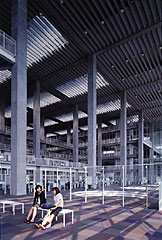
...The way of creating architecture alone can completely change an educational system. The members of the planning committee are well aware of this fact. The relationship between an environment and the activities that take place within it is extremely sensitive...This is a very flexible space in which people who want to be alone can secure places for themselves and yet, when they want to participate in group activities they can just turn around and join in. That flexible space is arranged in tiered platforms to suit the slope of the site. It is arranged so that the instructors’ research laboratories are located right nearby. The flexible space, called the ‘studio’, is based on the image of a design studio...It was also our idea to consciously incorporate a [systematic construction method] into the design process right from the beginning. That is the main reason we wanted to employ precast concrete [in the structure]... (Riken Yamamoto, “Shinkenchiku”, Sept. 2000)
|
|
|
Future University of Hakodate
(1997-2000)
location: Hakodate, Hokkaido Prefecture
principal use: university
site area: 166,403.77m2
building area: 13,287.03m2
total floor area: 26,839.55m2
structure: precast prestressed concrete, partly reinforced concrete and steel frame; 5 stories
maximum height: 21,590mm
architects: Riken Yamamoto & Field Shop
structural engineers: Kimura Structural Engineers
mechanical engineers: Sogo Consultants
landscape design: Asia Consulting Engineers
landscape design collaborators: SANAA
acoustic designers: Nagata Acoustics
furniture and sign producers: A Works
furniture designers: Yasuo Kondo Design Office
sign designers: Hiromura Design Office
textile designers: Taguchi Design Office
general contractors: JV of Taisei, Chibakensetsu, Katogumi, Itogumi, Sawada, Tabatakensetsu, and Sankokogyo
JV of Shimizu, Hirabayashi, Tokukensetsu, Ishiigumi, Wakokensetsu, and Tonumakensetsu
completion date: January, 2000
next
back
top
|