|
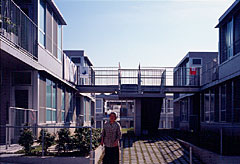
...[This is a project for council housing that has been rebuilt to accommodate the aging residents. For that reason, we decided on low-rise buildings that utilize the form of the site and the existing road. The result is] a scheme with a series of enclosures consisting of approximately 10 households each. For the ground level we assumed the residents would be elderly singles or couples and designed the courtyards to admit care vehicles and so on. In standard terms the apartments would be 1DK (one bedroom, combined dining room and kitchen)...We thought of [the presence of occupants receiving nursing care] as an opportunity to take units which would typically be closed in by steel doors and open them up to the outside. As a result, the design of the corridors facing those units changes and it also makes it possible for people other than residents of that building to enter, so security concepts change as well. I think that as soon as units are opened to the outside of the building, the style of multi-unit housing becomes decisively different. (Interview with Riken Yamamoto, “Shinkenchiku”, Jan. 2001)
|
|
|
Yokohama Mitsukyo Housing
(1996-2000)
location: Seya-ku, Yokohama, Kanagawa Prefecture
principal use: multiple dwelling
site area: 12,625.52m2
building area: 4,704.70m2
total floor area: 7,600.78m2
structure: reinforced concrete; 2 stories, 3 stories
maximum height: 8,720mm
architects: Riken Yamamoto & Field Shop
structural engineers: Plus One Structural Des. & Eng. Firm
mechanical engineers: DAN Engineering
general contractors: JV of Sotetsu and Daiichi, JV of Nakawada and Takao, JV of Seki and Tsukasa, JV of Sumiyoshi and Showa
completion date: March, 2000
next
back
top
|